
Doubling down on structure, clarity, and authority in website content.
In the new AI-powered digital marketing environment the measures of success have shifted from having content ranked highly in organic search results and gauging the CTR for that content to having content cited by or mentioned in Generative AI agent responses and having those agents link to your website in their answers.
What are some effective tactics for improving your AI visibility?
The good news is that content marketing for AI search isn’t all that different from what you should be doing for organic search. The bad news is that some of the best practices for AI visibility incorporate the more detailed technical work that often gets left off traditional SEO efforts.
At a high level, if your goal is to be in mentioned or cited in Gen AI agent answers, the way to get there is to produce content that is:
- easily parsed and understood by an AI agent
- aligned with your target audiences’ intent and answers their specific question(s)
- concise and authoritative
Adding Schema Structure
“The principles of technical SEO have always been essential for visibility: ensuring a site is crawlable, structured, and performant. In an AI-driven environment, these fundamentals take on an even greater significance, serving as critical structural signals of trust and clarity for AI models. This makes strong technical optimization a prerequisite for content to be accurately interpreted and featured as a source.”
—Monogram.io
Adding schema markup to your content is arguably the most important step in our list. That is because schema will provide AI agents (and other automated browsing tools) with explicit details about the context and purpose of your content.
Schema is essentially a labeling system that, when properly applied, helps programmatic systems such as search bots or AI agents understand content more fully. These labels are applied on the backend of a webpage or other content, meaning they’re not seen by a user viewing that content in their browser or device.
Schema tagging describes content and its properties. So, for instance, if an AI agent is scanning an attorney’s online profile on a law firm website, and if that page is using well-crafted schema markup, the AI agent can unambiguously understand the details of that profile. This means that name, title, education, awards, experience and other data fields will be conveyed directly to the agent.
Here is an example of an attorney profile page that is using in-depth schema tagging. And here is how that schema markup breaks the page content into labelled parts. (See images below.)
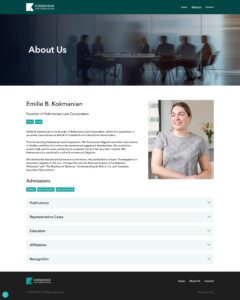
An example attorney bio
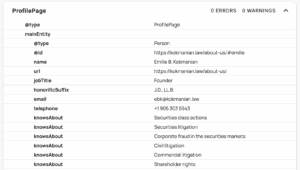
Snippet of the detailed schema markup used on that bio
Without schema tagging, any programmatic browser consuming content like this has to interpret the content it finds and create its context using whatever signals exist on the page or website. That can lead to inaccuracies, misunderstandings or other misinterpretations.
When it reads properly applied schema on a page, an AI agent will understand the content on that page at a granular level. It will know what values apply to what properties. And with that context and accuracy, the authority and value of the information in the eyes of the AI agent increases, making it more likely to be cited in that agent’s generative answers.
From Keywords to Conversations
Traditional search is about matching keywords. When a user searches for “trademark law Nevada,” the search engine looks in its index for pages where those exact words (or combinations of them) appear and returns to the user a list of those pages, starting with those it feels are the closest match.
With Gen AI search this interaction is conversational. Users ask complete, specific and complex questions such as, “How do I register a trademark for my bicycle store in Reno, Nevada, and what are the steps for filing a claim against a store in my area that stole our logo?”
The AI agent might respond with a page or two of details and advice to answer such a question. It is also likely to ask follow up questions to clarify the user’s intent. And as part of that conversation the agent is going to reference, link to or cite websites and content that it feels helps the user answer their query.
Focus on Long Tail Keywords
For a law firm interested in finding clients through organic search, this represents a tectonic shift from producing content that targets high volume keywords to producing content that is more specific and focused on ‘long-tail’ keywords, topics and phrases where they want to be part of the AI’s answers.
“Targeting long-tail keywords could boost your visibility in AI-generated responses, which play a growing role in consumer behavior.” —SEMRush.com
There are two main reasons why long-tail keywords are good for AI search optimization:
- AI search is conversational. People tend to engage with AI systems conversationally by inputting highly specific queries. If you use long-tail keywords appropriately, your content is more likely to align with users’ language and influence the AI response.
- AI tools use query “fan-out,” which means expanding a user’s query into many related sub-queries to collect more varied information and generate a comprehensive response. Targeting long-tail keywords should increase your chances of being matched to one of these fan-out sub-queries and appearing in the AI response.
Choose Clarity over Length
For years the trend in SEO was that longer content was better. Generative AI has flipped this advice 180 degrees. AI search agents now prioritize content that is
- scannable
- logical
- informative
If an AI agent cannot quickly and effectively parse your content and if it can’t find relevant, authoritative information, it’s not likely to cite that page or post in its answers.
Structure for Scanability
Use headings, sub-headings, bullet points, and numbered lists in your content to increase its clarity to AI agents. Be sure to maintain a consistent logical structure to your headings and subheadings (and the HTML tags used for those headings) to communicate the hierarchy of your content.
Use the “BLUF” approach when writing. BLUF stands for “Bottom Line Up Front.” This means putting the answer to the question at the beginning of the article or post. Don’t bury it after a long anecdote (like the way recipe pages on any of the major cooking websites bury the actual recipe under pages of ads and anecdotes).
The Role of Authority: Being Cited vs. Ranking
In what we can now call ‘classic search marketing,’ the goal was (or still is) to get pages showing on the first page of the search results for targeted keyword phrases, ideally in the top 3.
In this new era of Generative AI search the goal is to have your content be source material for the AI agent’s answers. This requires that your content effectively signals to the Gen AI agent that it is trustworthy, credible and accurate.
In evaluating your content for AI visibility, we recommend using Google’s E-E-A-T principles. EEAT stands for Experience, Expertise, Authoritativeness, and Trustworthiness.
Experience: Does the author of the content (the individual or organization) have real-world experience with the subject?
Expertise: Is the author of the content a subject matter expert? Does the content exhibit a higher level of understanding than other pages focused on this subject?
Authoritativeness: Is the author of the content cited in other reputable sources on this subject? Are there backlinks from reputable sources to this page and its content?
Trustworthiness: Is the information accurate? Are there sources cited on the page? Is the website hosting the content secure and reputable? Is there contact information for the author or organization? Are there user reviews of the content?
If your content credibly checks off these boxes and you’re following the other recommendations in this article, you will be in good shape.
Conclusion
Generative AI search has not yet surpassed organic search in terms of referral traffic but it’s clear that it will before too long. The digital marketing world has fundamentally shifted the measure of digital success from simply achieving high organic search rankings to becoming the cited source material within an AI agent’s answer.
Succeeding in this new digital marketing paradigm doesn’t (yet) require inventing new and innovative tactics for AI agents. Rather it calls for a renewed commitment to some of the foundational elements of digital marketing that have been heralded for over a decade. To succeed in GEO your firm or organization should focus on:
- Unambiguous Authority: Integrate Schema markup to explicitly define your organization’s services and professionals, and to reinforce content authority.
- Specificity and Intent: Shift your content strategy from broad keywords to detailed, task-based, long-tail answers that match the conversational intent of your target audiences or ideal customers.
- Structural Clarity: Write and share content that is concise and scannable. Be sure to use the “Bottom Line Up Front” (BLUF) approach so AI agents can quickly and accurately parse your information.
By following these steps, your firm’s website and marketing content will be more frequently cited and mentioned by the new AI search engines.
About Tenrec
Tenrec is a website management agency that specializes in improving and optimizing business websites.
We approach AI readiness not as a one-time fix but as a critical piece of your enterprise’s website maintenance and marketing strategy.
Call or email us today to learn more about how Tenrec can help your business improve its visibility in AI search.